
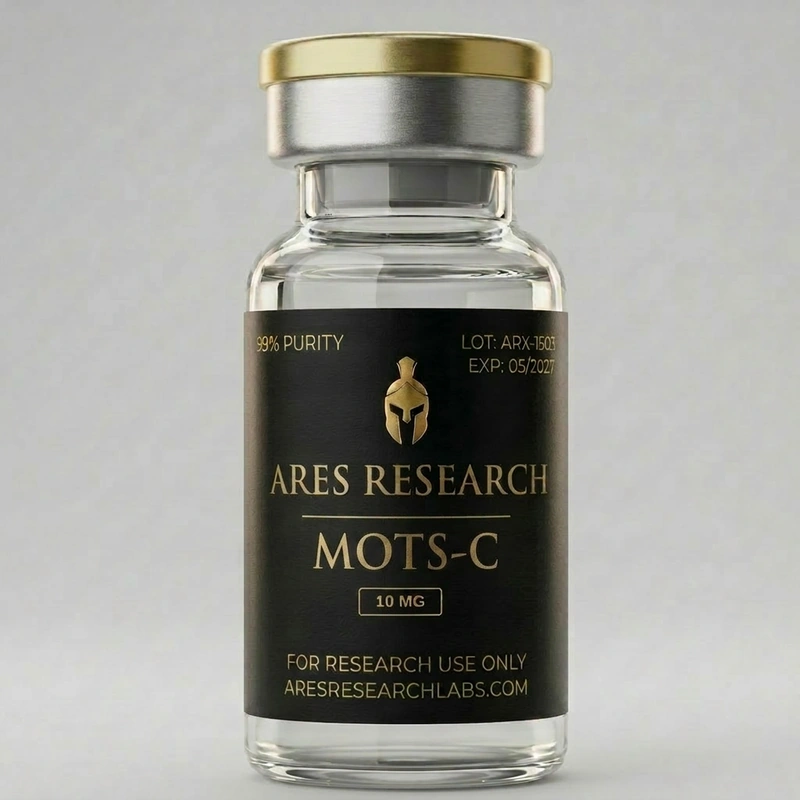
MOTS-C
Documentation & standards
- How to Read a Peptide Certificate of Analysis (COA)
- Peptide Storage and Handling: Temperature, Light and Stability
- Research-Use-Only Compliance: What the Label Obligates
Mitochondrial-derived peptide studied in metabolic regulation research.
Mix and match any items — discount applies automatically at checkout.
Reminder email when it's time to reorder. No card on file. Cancel anytime from your account — or email support@aresresearchlab.com.
Earn 49 loyalty points on this purchase · 100 pts = $5 off
Create a Research Account to unlock full batch data, COAs, and priority releases.
Intended strictly for controlled laboratory receptor and pathway research.
What is MOTS-C?
MOTS-C is a 16-amino-acid mitochondrial-derived peptide encoded within the 12S rRNA gene of mitochondrial DNA rather than the nuclear genome. That origin places it in the mitochondrial-derived peptide (MDP) family, where it is the most-characterised member in published literature.
Laboratory research examines MOTS-C primarily through AMP-activated protein kinase (AMPK) signalling: reduced folate-methionine cycle flux, AICAR-linked AMPK activation, and downstream markers including GLUT4 translocation, fatty-acid oxidation, and PGC-1α-associated mitochondrial biogenesis. Separate published work documents nuclear translocation under metabolic stress, where antioxidant-response and NRF2-pathway transcripts are measured. These are experimental endpoints in cell and animal research models only; no medical, therapeutic, or human-use outcome is described or implied.
MOTS-C is a soluble signalling peptide and is mechanistically distinct from SS-31, which is studied for cardiolipin binding and electron-transport-chain architecture; the two are listed as separate research materials.
MOTS-C COA lookup and verification
Each vial carries a batch identifier for checking the analytical documentation available for that material. Two third-party reports from Janoshik Analytical (June 2026), covering MOTS-C and MOTS-C 10mg, are on file, and the public lookup supports batch-level review. The transparency page explains the identity, purity, and documentation framework applied to every batch; general verification information is not presented as a vial-specific result.
MOTS-C research material specifications
| Compound | MOTS-C (mitochondrial open reading frame of the twelve S rRNA-c) |
|---|---|
| Structure | 16-amino-acid peptide encoded within the mitochondrial 12S rRNA gene |
| Class | Mitochondrial-derived peptide (MDP) research material |
| Purity specification | ≥99% |
| Physical form | Lyophilized powder in a sealed glass vial |
| Available vial sizes | 5 mg, 10 mg, 20 mg, 30 mg, and 40 mg |
| Research distinction | AMPK signalling, metabolic regulation, and mitochondrial-energy endpoints |
| Storage | Refrigerated, dry, and protected from light; follow batch documentation |
| Origin | Shipped domestically from the USA with tracked delivery |
| Intended scope | Controlled laboratory research only — not for human or veterinary use |
MOTS-C research questions
+What is MOTS-C?
MOTS-C is a 16-amino-acid mitochondrial-derived peptide encoded within the 12S rRNA gene of mitochondrial DNA. It is catalogued here as a laboratory reference material for controlled mitochondrial and metabolic-signalling research. It is supplied strictly for laboratory research use — not for human or veterinary use.
+What is MOTS-C studied for in laboratory research?
Published laboratory research examines MOTS-C as a regulator of AMP-activated protein kinase (AMPK) signalling, with endpoints covering folate-methionine cycle flux, glucose-uptake and GLUT4 translocation markers, fatty-acid oxidation, mitochondrial biogenesis via PGC-1α, and nuclear translocation to antioxidant-response gene targets. These are experimental measurements in cell and animal research models only; no medical, therapeutic, or human-use outcome is described or implied.
+Why is MOTS-C called a mitochondrial-derived peptide?
Unlike peptides encoded in nuclear DNA, MOTS-C is translated from a short open reading frame inside the mitochondrial genome using the mitochondrial genetic code. That origin is what places it in the mitochondrial-derived peptide (MDP) family and makes it a common reference material in mitochondrial-signalling literature.
+How does MOTS-C differ from SS-31 in research terms?
SS-31 binds cardiolipin on the inner mitochondrial membrane and is studied for electron-transport-chain architecture endpoints. MOTS-C is a soluble signalling peptide studied through AMPK activation and nuclear gene-expression endpoints. The two are mechanistically distinct research materials and are listed separately in the catalog.
+Is there a certificate of analysis for MOTS-C?
Two third-party analytical reports from Janoshik Analytical (June 2026), covering MOTS-C and MOTS-C 10mg, are on file. Batch-level documentation can be searched in the public COA lookup, and the transparency page explains the identity, purity, and documentation framework applied to every batch.
+What purity and identity testing applies to MOTS-C?
Each batch is tested against a ≥99% purity specification by HPLC with identity confirmation by mass spectrometry, consistent with the published testing standards. Batch documentation is released with orders and indexed in the COA lookup.
+What vial sizes are available?
MOTS-C is supplied as a lyophilized powder in sealed glass vials in 5 mg, 10 mg, 20 mg, 30 mg, and 40 mg formats, each carrying a batch identifier that maps to its analytical documentation.
+How should MOTS-C be stored, and how does it ship?
Store the sealed lyophilized vial refrigerated, dry, and protected from light, and follow the batch documentation supplied with the vial. Orders ship domestically from the USA with tracked delivery. All material is intended strictly for controlled laboratory research.
Read the MOTS-C research
A mitochondria-derived peptide encoded within the 12S rRNA gene, studied for its role in metabolic regulation, insulin sensitivity, longevity signaling, and exercise adaptation in cellular and animal research models.
Read article →What is MOTS-c? Mitochondrial-derived peptide research mechanisms and findings.
Read article →Mitochondrial-derived peptide biology, AMPK activation, folate-cycle interaction, and the exercise-mimetic signalling that defines MOTS-c in research.
Read article →Compare MOTS-c (mitochondrial-derived peptide) and 5-Amino-1MQ (NNMT inhibitor) in metabolic and mitochondrial research models.
Read article →Researcher Reviews
Sign in with the account that placed your order to leave a verified review.
Ask the Lab
No public questions yet — be the first to ask.
Independent Certificate of Analysis
Independently tested by Janoshik Analytical. Verified and batch-tracked by Ares Research. Additional reports available upon request.
No fillers. No shortcuts. Only verified compounds.