
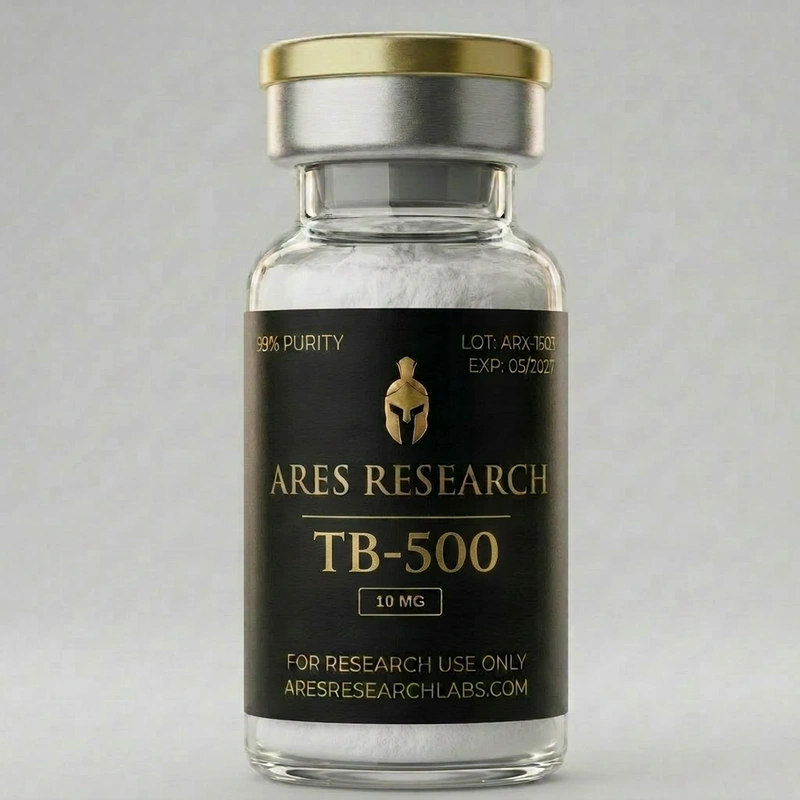
TB-500
Documentation & standards
- Third-Party Peptide Testing: HPLC, Mass Spec & What Each Proves
- Peptide Purity Verification: Turning a Claim Into Evidence
- How to Read a Peptide Certificate of Analysis (COA)
Synthetic Thymosin Beta-4 fragment studied in actin-binding, cell-migration, and angiogenesis research endpoints.
Mix and match any items — discount applies automatically at checkout.
Reminder email when it's time to reorder. No card on file. Cancel anytime from your account — or email support@aresresearchlab.com.
Earn 29 loyalty points on this purchase · 100 pts = $5 off
Create a Research Account to unlock full batch data, COAs, and priority releases.
Intended strictly for controlled laboratory receptor and pathway research.
What is TB-500 (Thymosin Beta-4 fragment)?
TB-500 is a synthetic peptide fragment corresponding to the actin-binding region of Thymosin Beta-4, a naturally occurring intracellular protein. It is catalogued as a laboratory reference material for controlled structural and pathway work.
Published laboratory research examines actin sequestration and polymerisation dynamics, cell-migration assays, angiogenesis-related endpoints, and tissue-repair models in controlled systems. These are experimental measurements in research models only; no medical, therapeutic, or human-use outcome is described or implied.
TB-500 is structurally distinct from BPC-157, which is studied through separate pathway endpoints and listed as its own research material, alongside a separate combined blend listing.
TB-500 COA lookup and verification
Each vial carries a batch identifier for checking the analytical documentation available for that material. The public lookup supports batch-level review, while the transparency page explains the identity, purity, and documentation framework. General verification information is not presented as a compound-specific result.
TB-500 research material specifications
| Compound | TB-500 (synthetic Thymosin Beta-4 fragment) |
|---|---|
| Structure | Synthetic peptide fragment corresponding to the actin-binding region of Thymosin Beta-4 |
| Class | Thymosin Beta-4 fragment research peptide |
| Purity specification | ≥99% |
| Physical form | Lyophilized powder in a sealed glass vial |
| Available vial sizes | 2mg, 5mg, and 10mg |
| Research distinction | Actin-binding, cell-migration, and angiogenesis-related laboratory endpoints |
| Storage | Refrigerated, dry, and protected from light; follow batch documentation |
| Origin | Shipped domestically from the USA with tracked delivery |
| Intended scope | Controlled laboratory research only — not for human or veterinary use |
TB-500 research questions
+What is TB-500?
TB-500 is a synthetic peptide fragment corresponding to the active region of Thymosin Beta-4, a naturally occurring actin-binding protein. It is supplied as a laboratory reference material for controlled research on actin regulation and related cellular endpoints.
+What does TB-500 research examine?
Published laboratory work examines actin sequestration and polymerisation, cell-migration assays, angiogenesis-related endpoints, and tissue-repair models in controlled systems. These are experimental measurements in research models, not medical or human-use claims.
+How is TB-500 related to Thymosin Beta-4?
Thymosin Beta-4 is a 43-amino-acid protein. TB-500 corresponds to the short actin-binding sequence within it, which is why the two names appear together in literature. They are related but structurally distinct research materials.
+How does TB-500 differ from BPC-157?
TB-500 is a Thymosin Beta-4 fragment studied through actin-binding and cell-migration endpoints. BPC-157 is a separate pentadecapeptide studied through different pathway endpoints. They are distinct compounds and are listed as separate research materials, alongside a separate combined blend listing.
+How is TB-500 tested, and how can a batch be checked?
Each vial carries a batch identifier that can be entered in the public COA lookup to review the analytical documentation available for that material. The transparency page explains the identity, purity, and documentation framework applied to research materials.
+What purity specification applies to TB-500?
The listed release specification is ≥99% purity. Researchers should confirm the result associated with the received material using its batch identifier rather than relying on general verification information.
+How should TB-500 be stored and shipped?
Sealed lyophilized vials should be kept refrigerated, dry, and protected from light, following the storage information supplied with the batch. Orders ship domestically from the USA with tracked delivery.
Read the TB-500 research
Thymosin Beta-4: actin sequestration, tissue repair, angiogenesis, and cardiac protection research — a complete mechanistic and evidence overview.
Read article →What is TB-500? Thymosin beta-4 fragment research mechanisms and applications.
Read article →Proposed mechanisms of the thymosin β4 active-region fragment TB-500: G-actin sequestering, KLF2-mediated angiogenesis, AcSDKP release and anti-inflammatory cytokine modulation.
Read article →Researcher Reviews
Sign in with the account that placed your order to leave a verified review.
Ask the Lab
No public questions yet — be the first to ask.
Independent Certificate of Analysis
Independently tested by Janoshik Analytical. Verified and batch-tracked by Ares Research. Additional reports available upon request.
No fillers. No shortcuts. Only verified compounds.